

PRODUCT
VisionOne™: revolutionizing glaucoma diagnosis and monitoring
For ophthalmologists and optometrists specialized in glaucoma, VisionOne™ is the VR visual field platform with industry-leading speed and accuracy. We combine patented AI, Swiss engineering, and international clinical validation to deliver highly reliable results and strong correlation to the gold standard.
VisionOne™: VR & cloud platform
VisionOne™ is designed with the clinical user and patient in mind. Its features deliver clinical productivity, trusted results and a superior patient experience.
Automated, multi-language voice guide that instructs and assists patients in real-time, reducing the need for constant technician supervision.

Patented AI algorithm that delivers clinical results 60–70% faster than traditional methods while maintaining high diagnostic precision.

SORS, SORS screening, Normal Strategy, Dynamic Strategy, Supra-threshold
10-2, 24-2, 30-2, G, Esterman (120 degree), Screening 28, C-40
New "Standard (III, adaptive)" option allows dynamic scaling of stimulus size to expand the effective luminance range. Includes full greyscale legends, raw VR data display without offset, and validation for non-responses.
Stimuli are now rendered on a spherical surface rather than a plane for all tests except binocular Esterman, aligning more closely with standard perimetry devices.
Stimulus interval adapts to patient response time, speeding up tests for faster responders. New "Standard (2500, adaptive)" mode adjusts the interval between 2500 ms and 1000 ms. Logs include update rates and results show "Average Stimulus Interval [ms]".
Specialized ergonomic insert that allows patients to test with standardized corrective lenses.

Active sensor-based monitoring that detects gaze fixation and ensures reliability.

Export of exam results in standardized PDF format, ensuring compatibility with hospital systems.

Current features
Smarter testing, faster insights.
Leverage patented AI and cloud connectivity to transform how you monitor and manage functional vision.

Coming soon features...
COMING SOON
VFT AI-supported progression analysis
Fixation Independent Perimetry
Visual acuity
Contrast sensitivity
Color vision
Amsler Grid
STATISTICS
Trust our clinically validated technology
SORS: AI-Enhanced Perimetry
The Sequentially Optimized Reconstruction Strategy (SORS) is an AI-based meta-strategy developed to minimize test duration without compromising accuracy. SORS utilizes machine learning algorithms trained on thousands of visual field tests to identify an optimal "testing path." By evaluating a specific subset of test locations (e.g., 20 or 36 points), the system can reconstruct the untested locations using linear approximation and learned correlations between retinotopic locations.
-
Clinically proven to be up to 70% faster than the traditional SITA Standard strategy, reducing average test time from ~11 minutes to approximately 2–3 minutes per eye.

-
Maintains a high correlation for MD (R = 0.91) with the clinical gold standard.

SORS: validation results
26–39% reduction in test–retest variability compared with the Dynamic Strategy.
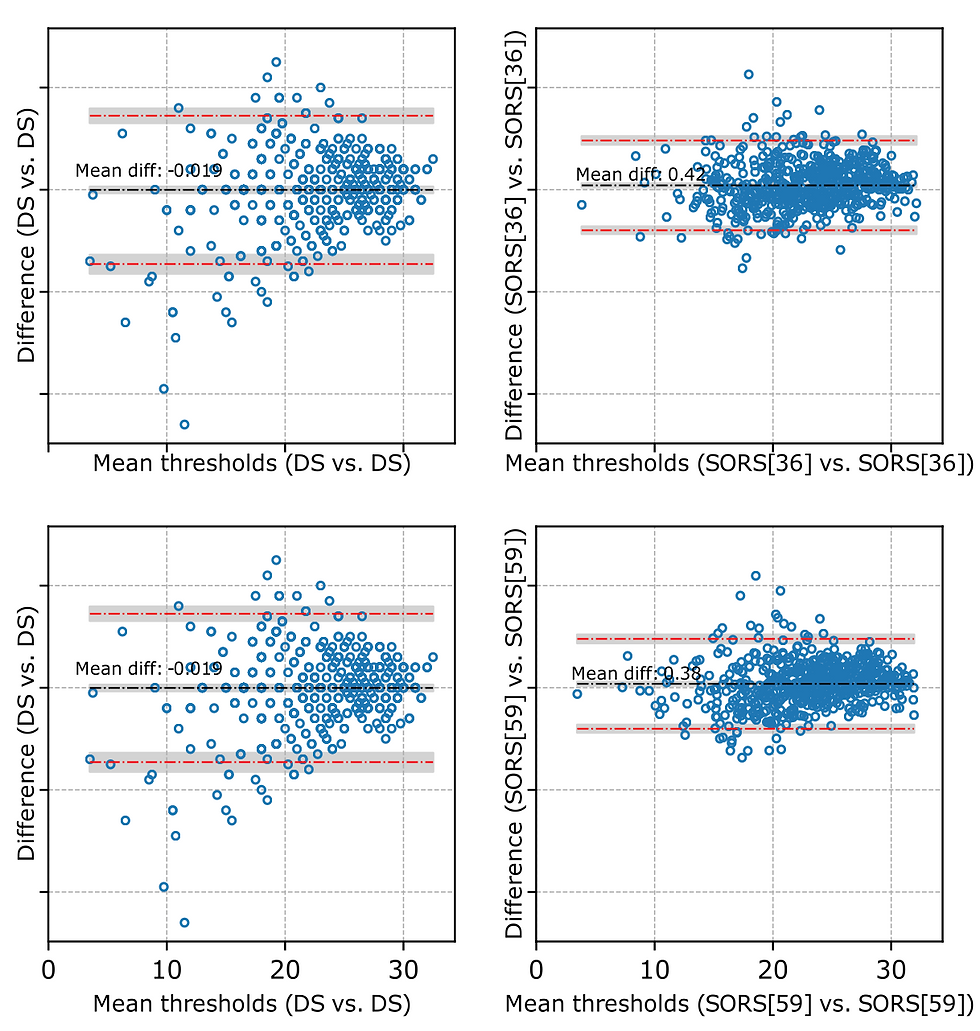
i.e. standard deviations and limits of agreement for SORS test-retest differences were smaller than those for DS. This suggests that SORS VFTs are reliable enough to decouple glaucoma progression from measurement variation. The variation between SORS and DS was also similar (even smaller) than DS test-retest variability, as illustrated by the standard deviation and limits of agreement lines. This points to non-inferiority of SORS compared to DS.
1.30 dBs
Test-restest variability (vs. 1.71 for SITA*)
Adaptive stimulus
Allows us to test the full spectrum of disease, validated in study with R = 0.96 including advanced glaucoma
Figure: Comparison of visual field global indices between the VisionOne™ (VO) and Octopus 900. Each point represents one eye (N = 100). Solid red lines indicate the Deming regression fit. Pearson correlation coefficients demonstrate strong linear associations between devices for mean sensitivity (MS: ρ = 0.91, p < 0.0001) and mean defect (MD: ρ = 0.90, p < 0.0001). Corresponding Deming regression coefficients were ρd = 0.97 for MS and ρd = 0.96 for MD.

*Forthcoming publication
Enhance patient experience and increase clinic productivity
21-30%
Additional patient volume with PeriVision estimated by eye doctors in market survey (median reply)

-63%
Technician time for visual field with VR assistant (based on clinical study data)
100%
Flexibility - free up space and test anywhere in your practice

95%
Patients perceiving system as easy to use (based on patient survey during clinical study)
EYE TESTING
Sationary
Resource-intense
Unreliable / limited insight
Yesterday


EYE TESTING
Today
Portable
0.6kg, usable everywhere
Cost efficient
5 min, 0 assistant, 0 room, SW-subscription
Deeper insight
26-38% less data variability, high comfort
Correlation with DS (r = 0.927, p < 0.001)
High
Reduction in inter-test variability
26-39%
Test-retest variability (vs. 1.71 for SITA)*
1.30 dBs
Comparable clinical decisions vs. DS
Equal
Clinical agreement between SORS and DS than between different assessors on DS
Better
STATISTICS
What could be the title here?


LEARN MORE
How it works
AI, VR & Cloud
